How Semtech Out-of-Band Management Helps WISPs and ISPs Reduce Operating Costs, Resolve Outages Faster, and Protect Customer Relationships
The Urgent Issue
For Wireless Internet Service Providers (WISPs) and Internet Service Providers (ISPs), network downtime is more than a technical inconvenience. It is a business problem that impacts operating costs, customer satisfaction, employee productivity, and ultimately, profitability.
As broadband providers expand into rural and underserved communities, their networks become increasingly distributed. Remote towers, fiber cabinets, aggregation sites, and network equipment may be located miles from the nearest technician.
When a primary network connection fails, operators can lose access to the very equipment needed to diagnose the problem. What might otherwise be a quick configuration fix can turn into hours of troubleshooting, an unnecessary truck roll, or an extended service outage.
Out-of-Band Management (OOBM) changes that equation by providing an independent communications path to critical network equipment—even when the primary connection is unavailable.¹
Why Traditional Network Management Costs Providers More Than They Realize
Many WISPs and ISPs operate with lean technical teams responsible for maintaining dozens or hundreds of geographically dispersed sites.
Without independent management connectivity, a network outage can trigger a costly chain reaction:
- Unnecessary truck rolls: Technicians must travel to remote locations simply to diagnose problems that might be resolved remotely.
- Extended downtime: When equipment becomes unreachable, identifying the root cause takes longer.
- Lost productivity: Skilled network engineers spend valuable time troubleshooting connectivity rather than expanding or optimizing the network.
- Increased customer support demands: Longer outages generate additional customer calls, complaints, and service escalations.
- Revenue and retention risks: Repeated outages can undermine subscriber confidence and increase the likelihood of cancellations.
The challenge is particularly significant for rural providers, where a single service visit may involve hours of travel
Why Out-of-Band Management Changes the Equation
Traditional in-band management relies on the same network infrastructure that carries customer traffic. When that connection fails, management access may disappear with it.
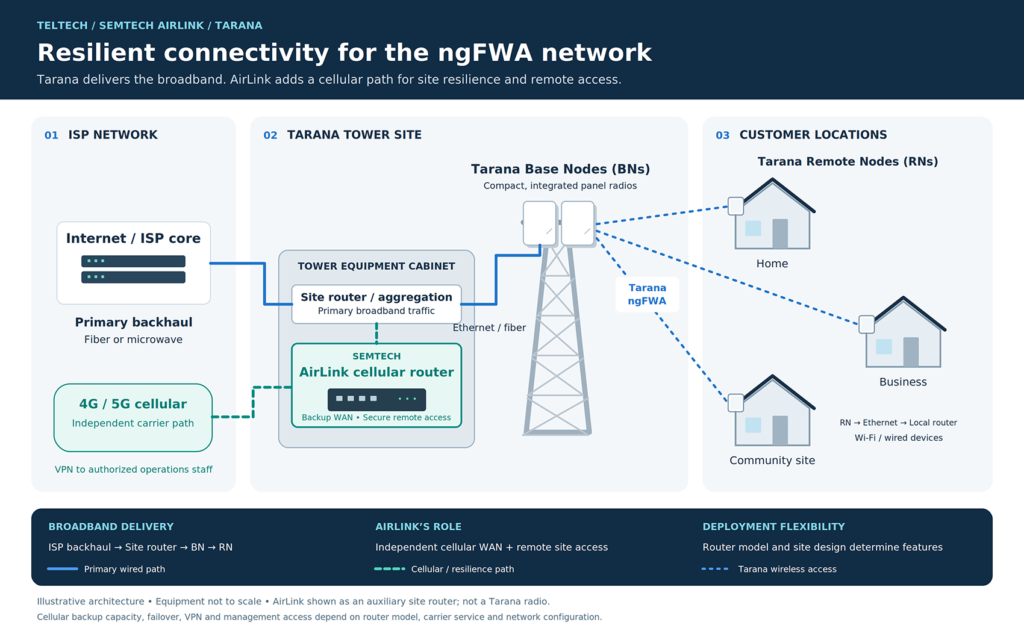
Out-of-Band Management provides a separate pathway for diagnosing and managing equipment.
Using a dedicated cellular connection through a Semtech AirLink® router, operators can maintain an alternative route into critical infrastructure, subject to cellular availability and site power.
Semtech describes its AirLink OOBM capabilities as a means of last-resort troubleshooting and remote reconfiguration, including checking router status, retrieving diagnostic logs, and repairing configurations.¹
For WISPs and ISPs, this translates into tangible operational advantages:
- Faster identification of network problems
- Remote troubleshooting and configuration changes
- Fewer avoidable field dispatches
- More efficient use of technical resources
- Better visibility across distributed network assets
Importantly, OOBM does not prevent every outage or automatically restore subscriber service. Its value lies in helping operators diagnose problems and take corrective action without immediately dispatching technicians.
What OOBM Can Mean for Your Bottom Line
Consider a hypothetical WISP operating 100 remote network sites:
- Remote sites = 100
- Avoided truck rolls per month = 4
- Estimated cost per truck roll = $500
- Avoided truck rolls per month = 4
- POTENTIAL ANNUAL GROSS SAVINGS $24,000*
*Before OOBM equipment, cellular data, subscriptions, integration, and support costs.
Illustrative scenario only, not a documented Teltech or Semtech customer result. Actual savings depend on network conditions and operational practices.
And that’s only the direct cost of field dispatches.
When network engineers can diagnose problems remotely, they spend less time traveling and more time on higher-value activities, including new subscriber installations, network optimization, and infrastructure expansion.
Where OOBM Delivers the Greatest Value
Rural Wireless Networks
WISPs operating remote towers and fixed wireless sites can use independent management connectivity to investigate equipment failures without immediately sending a technician into the field.
Fiber Access and Aggregation Networks
ISPs can maintain an alternative management path to compatible switches, routers, and other network equipment in fiber cabinets, huts, and aggregation facilities. This is particularly valuable when the primary fiber transport connection is interrupted.
Multi-Site Broadband Operations
Providers managing large networks can standardize monitoring, configuration management, and troubleshooting procedures across geographically dispersed locations.
Lean Network Operations Teams
For smaller providers without extensive 24/7 field resources, remote diagnostics can help existing personnel manage more infrastructure without a proportional increase in operating costs.
How Semtech AirLink Routers Make OOBM Possible
Semtech’s ruggedized AirLink routers provide the connectivity foundation for secure remote network access.
When paired with AirLink Management Service (ALMS) and an appropriately configured management architecture, supported AirLink routers enable centralized device visibility, remote configuration, diagnostics, and management across distributed locations.²
Key capabilities include:
- Independent Cellular Connectivity
- A dedicated LTE/5G management connection provides an alternative communications path when primary fiber or wireless connectivity is unavailable.
- Remote Monitoring and Diagnostics
- Operators can monitor AirLink router health, review operational information, and troubleshoot supported configurations remotely.
- Centralized Device Management
- ALMS enables providers to manage multiple AirLink routers through a centralized platform, helping simplify administration as networks expand.³
- Secure Remote Configuration
- Supported remote management features allow operators to modify router settings and deploy firmware or security updates without visiting each location.⁴
- Ruggedized Hardware
Semtech’s industrial and mission-critical AirLink portfolio is designed for demanding environments, making it suitable for many remote broadband infrastructure applications.
The result is a management architecture that helps transform network maintenance from a predominantly reactive, field-intensive activity into a more efficient remote-first operation.
How Teltech Turns OOBM Technology Into Business Value
As an authorized Semtech distributor and network solutions provider, Teltech helps WISPs and ISPs move beyond purchasing individual routers to implementing an integrated OOBM strategy.
Through its Network Integration Services and technology distribution capabilities, Teltech can support:
- Network assessment and design: Identifying critical sites where independent management access offers the greatest operational benefit.
- Equipment selection and sourcing: Matching Semtech AirLink routers and connectivity options to the requirements of each deployment.
- Preconfiguration and testing: Preparing equipment before shipment to simplify field installation.
- Site kitting and logistics: Coordinating equipment, accessories, and deployment materials for multiple locations.
- Network integration: Connecting OOBM infrastructure to compatible existing management systems and operational workflows.
- Lifecycle support: Helping customers maintain and scale their management infrastructure as their networks grow.
By combining Semtech technology with Teltech’s engineering, integration, and logistics expertise, providers can implement OOBM as a repeatable operational solution rather than another collection of standalone devices.
The Competitive Advantage of a More Efficient Network
For WISPs and ISPs, profitability depends on more than subscriber growth. It also depends on controlling the cost of serving those subscribers.
Every avoidable truck roll, extended outage, and unnecessary troubleshooting session consumes resources that could otherwise support network expansion and customer acquisition.
Out-of-Band Management helps providers address those inefficiencies by giving technical teams greater visibility and control over distributed infrastructure.
And as networks grow, those efficiencies become increasingly valuable.
The real benefit of OOBM isn’t simply better network management. It’s the ability to operate a larger, more reliable network without proportionally increasing operating expenses.
Stop Sending Technicians to Solve Problems You Could Fix Remotely
If your organization manages remote towers, fiber access sites, or distributed broadband infrastructure, it’s time to evaluate how much unnecessary expense is built into your current troubleshooting process.
Teltech can help identify where Semtech AirLink Out-of-Band Management can reduce operating costs, improve network visibility, and make your technical team more productive.
Sources
- Semtech Learning Center, “XR Solution Technical Certification Training — ALMS Out-of-Band Management.” Training material describing OOBM as a last-resort troubleshooting path for checking router status, retrieving logs, and repairing configurations. View training resource.
- Semtech, “Semtech Delivers Advanced 5G Capabilities for Public Safety,” October 2025. Documents AirLink remote management and OOBM capabilities through ALMS for supported router models. Read announcement.
- Semtech, “The Importance of Registering Your AirLink Router,” February 2, 2024. Explains centralized router monitoring, management, configuration, and support through ALMS. Read article.
- Semtech, “Don’t Let Your Network Security Expire; It’s Time for a Refresh,” 2024. Explains how ALMS supports remote firmware and security updates across fleets of routers. Read article.
- Semtech, “More Than Just Speed: The Key Factors Determining Your 5G Router’s Performance,” 2024. Discusses intelligent connectivity management, network switching, and centralized router control. Read article.